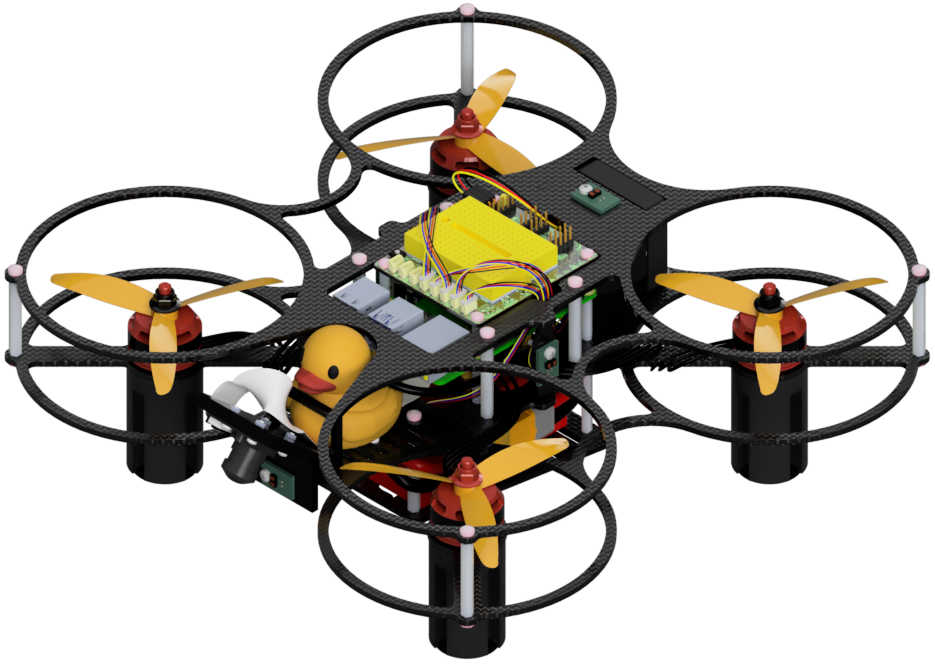
Software Architecture
Contents
Software Architecture#
The Duckiedrone DD24-B flight stack runs in Docker containers. Sensor drivers publish data through dtps, and ROS 2 bridge containers make the required sensor data and flight-controller services available to ROS 2. PX4 runs on the physical flight controller and performs the vehicle estimation and control.
Note
The architecture diagram formerly shown here describes the legacy ROS 1/core stack and does not represent the current Duckiedrone DD24-B deployment. See Duckiedrone Containers for the current container inventory.
Hardware interfaces#
Driver containers interface with hardware and publish their data through dtps. Companion ROS 2 bridge containers republish the data for ROS 2 consumers.
Camera driver#
driver-camera captures camera frames and publishes them through dtps. ros2-camera republishes the camera feed as a ROS 2 topic.
Flight Controller driver#
On a physical Duckiedrone, PX4 runs on the flight controller. The ros2-mavros container bridges PX4 to ROS 2, exposing flight-controller state and telemetry, accepting commands, and handling arming requests. The base Duckiedrone stack also declares dt-px4 and mavlink-proxy; dt-px4 provides a software-in-the-loop PX4 simulation only for virtual Duckiedrones, while the role of mavlink-proxy depends on the deployed robot configuration.
ToF driver#
driver-tof-bottom reads the downward-facing Time-of-Flight sensor and publishes its range measurement through dtps. ros2-tof-bottom republishes that reading to ROS 2. The downward-facing sensor is required for the standard flight stack; additional ToF sensors are optional.
Core flight functionality#
PX4 runs the core estimator and control loops on the flight controller. The companion-computer containers provide sensor data, ROS 2 accessibility, and Dashboard communications; they do not replace PX4’s low-level flight control.
Note
The node names in the following subsections come from older stack manifests. ros1/duckiedrone declares fly_commands_mux, while core/duckiedrone declares pid-controller, state-estimator, and visual-odometry. The current Duckiedrone updater selects the ROS 2 stack by default, so it does not select these legacy stacks.
IMU Node#
PX4 reads the flight controller’s IMU and uses it to estimate attitude. ros2-mavros exposes flight-controller IMU telemetry to ROS 2. In the standard Duckiedrone DD24-B configuration, PX4 uses the IMU for attitude estimation but does not fuse GPS, external vision, or optical flow.
Flight Controller Node#
The current stack has no separate flight_controller_node. ros2-mavros connects PX4 with ROS 2, reports vehicle state and telemetry, receives manual or external-control input, and provides arming and mode-control services. The Dashboard communicates with ROS 2 through ros2-rosbridge-websocket.
ToF Node#
The current stack uses driver-tof-bottom and ros2-tof-bottom. PX4’s EKF2 uses the downward-facing ToF sensor as its configured height source; it provides altitude information but no horizontal position estimate.
FlyCommandsMux Node#
fly_commands_mux is declared by the legacy ros1/duckiedrone stack, not by the current default update stacks. In the current manual workflow, control passes from the Dashboard’s Remote Control widget through MAVROS; an external controller in OFFBOARD mode publishes its own supported MAVROS setpoint stream and must meet PX4’s offboard-control requirements.
rosbridge#
ros2-rosbridge-websocket allows the web Dashboard to communicate with ROS 2 through a WebSocket interface.
Autonomous flight functionality#
The default Duckiedrone update starts the robot/basics, duckietown/duckiedrone, and ros2/duckiedrone stacks. These stacks do not declare an autonomous horizontal position-control node. A separate ros2-core/duckiedrone stack defines an altitude container, but it is not part of the default update stack set. The supplied PX4 configuration disables GPS, external vision, and optical-flow fusion, so it does not provide a standard autonomous horizontal position-control pipeline. PX4 OFFBOARD mode is available only when a custom controller supplies compatible setpoints and the estimates required by those setpoints.
PID#
The legacy core/duckiedrone stack declares a pid-controller service. PX4’s built-in control loops manage attitude, yaw rate, and altitude in the current standard stack. The manual does not publish a validated separate PID-controller-node workflow for the Duckiedrone DD24-B; use the supplied PX4 configuration and the guidance in PID control on the Duckiedrone.
State Estimator#
The legacy core/duckiedrone stack declares a state-estimator service. PX4’s EKF2 provides the state estimate used by the flight controller in the current standard stack. It uses the downward-facing ToF sensor for height and does not fuse GPS, external vision, or optical flow, so it must not be treated as a source of horizontal position or velocity estimates.
Optical Flow#
The legacy core/duckiedrone stack declares a visual-odometry service. The current camera stack streams imagery for the Dashboard but does not deploy an optical-flow node for flight control. The supplied PX4 configuration disables optical-flow fusion.
Rigid Transform#
Neither the legacy ROS 1/core manifests nor the current default stacks declare a separate Rigid Transform service. The camera is not used to produce a horizontal position estimate in the current standard stack.
Topics naming#
The current ROS 2 topic set comes from the containers running on the Duckiedrone. Inspect it from a ROS 2 environment before relying on a topic name:
ros2 topic list
ros2 topic echo /mavros/state
Flight Controller Node#
The legacy ~/flight_controller_node/... topics and services are not part of the current Duckiedrone DD24-B deployment. Use ros2-mavros to inspect PX4 state, telemetry, arming, and mode-control interfaces. /mavros/state is the primary flight-controller state topic; depending on the deployed MAVROS plugins, telemetry may also include /mavros/imu/data, /mavros/battery, and /mavros/altitude.
IMU Node#
The current stack has no separate imu_node. IMU telemetry is exposed through MAVROS when its plugin is available. Confirm the topic with ros2 topic list before subscribing.
ToF Node#
The current stack has no bottom_tof_driver_node. ros2-tof-bottom republishes the downward-facing ToF reading to ROS 2; inspect the running topic list instead of using the legacy ~/bottom_tof_driver_node/range name.