Reference frames
Contents
Reference frames#
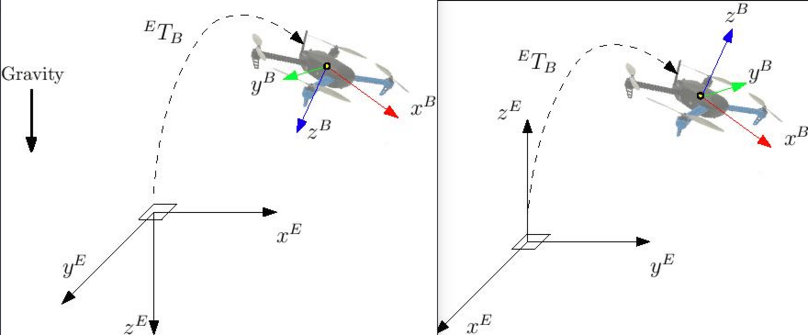
The Duckiedrone DD24-B uses ROS 2 on the Raspberry Pi and PX4 on the flight controller. Their standard body and local/world reference frames differ, so vectors and attitudes that cross an interface must be expressed in the expected frame. The diagrams below also compare the legacy Betaflight body-axis convention.
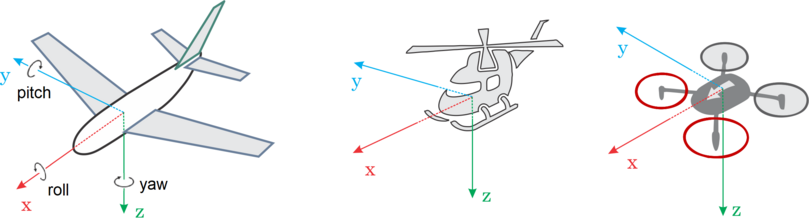
PX4 and the legacy Betaflight convention#
PX4 uses a forward-right-down (FRD) body frame: x points forward, y points right, and z points down. Its conventional local/world frame has north-east-down axes: x points north, y points east, and z points down. PX4 uses these FRD and north-east-down conventions on its topics unless a message definition states otherwise.1
The legacy Betaflight illustration uses the same FRD body-axis orientation. This comparison concerns body axes only; it does not make PX4 and Betaflight interfaces interchangeable.
ROS 2#
ROS 2 does not enforce a single runtime frame convention. For mobile robots such as the Duckiedrone, REP 103 and REP 105 describe the usual conventions. In a robot body frame such as base_link, the preferred orientation is forward-left-up (FLU):
xforwardyleftzup
For local Cartesian frames such as map and odom, the conventional orientation is east-north-up (ENU): x east, y north, and z up. REP 105 defines the roles and relationships of frames such as base_link, odom, and map.
At the ROS 2/PX4 boundary, a body-frame vector converts from FLU to FRD as (x, y, z) to (x, -y, -z). A world-frame vector converts from ENU to PX4’s north-east-down convention as (x, y, z) to (y, x, -z). Attitude quaternions also require the corresponding frame conversion.1
The image below compares the two reference-frame conventions.